

Who is working the peptide beat?
These journalists are on the case as the age of the N=1 mad scientist arrives.

I’m calling it: Peptide self-experimentation will be the next gigantic story. In fact, it already is.
Ozempic and the GLP-1 weight-loss drugs have been the biggest development in health of my lifetime — they are basically the artificial intelligence of medicine. The New York Times reported yesterday that the FDA will lift its ban on 14 popular peptides any day. That lid is bopping and bouncing as the brew boils beneath.
That lid’s going to pop off any day.
Without bans, peptide vials can be prepared in American labs, which will make them safer and more consistent for everyone. And the people are ready to do more at home injections. Fear of needles is not so widespread as it was.1
This story is much bigger than a new category of drugs, though.
All my life, medicine has been about getting back to homeostasis, just returning to baseline, but we’re on the verge of a kind of medicine that lets you have more of what you want out of life.
More sex?
More muscle?
More brain power?
More sleep?
More laser beams?
Who knows what might work!
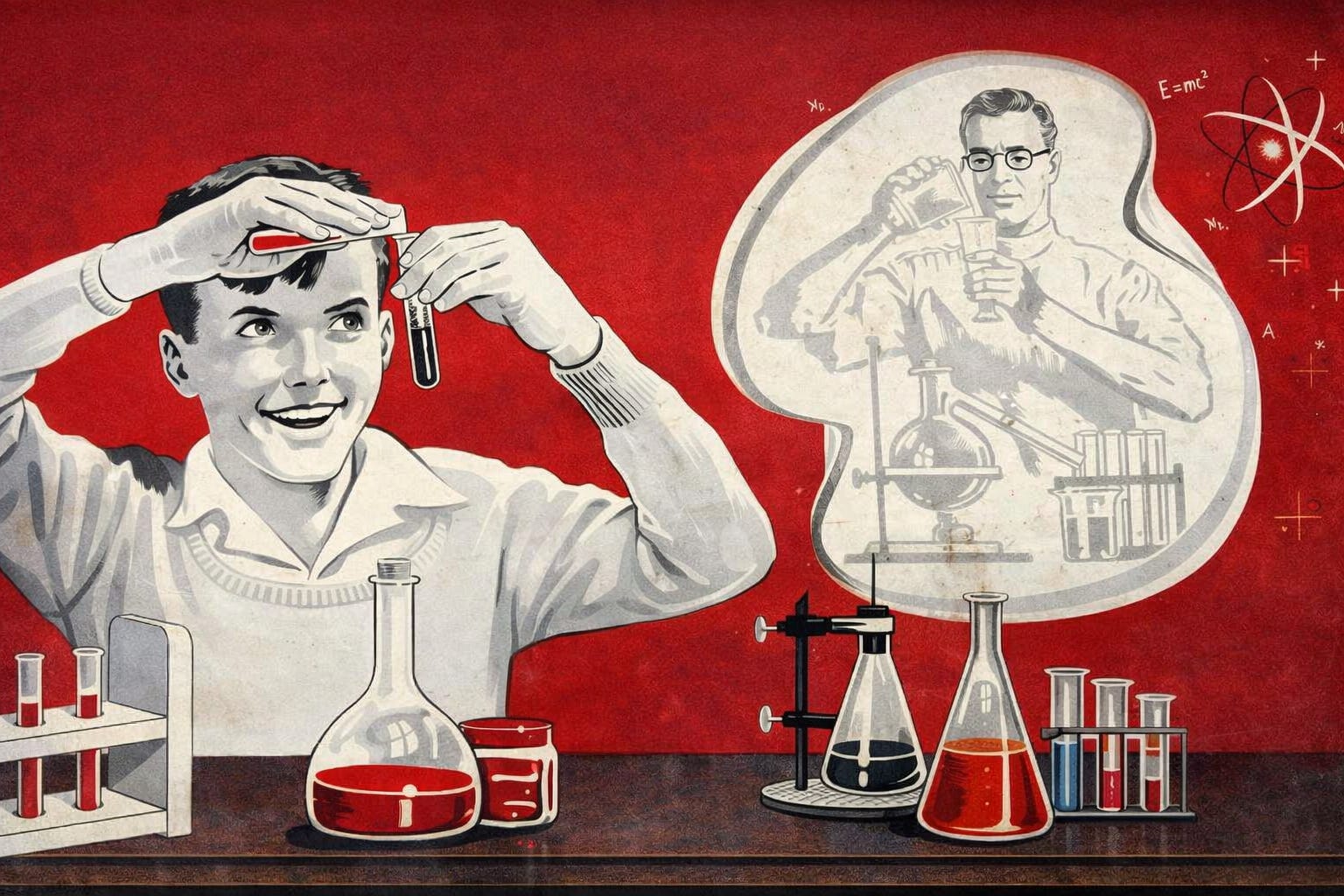
The question you need to ask now is: Where will you put your home health lab? You can be the N=1 mad scientist that 1960s comic books warned us all about.
Zombies
Google Trends, the internet’s barometer, shows that peptides are headed for escape velocity.
Pro-tip for Google Trends: Baseline your checks with something unrelated. I like to use “zombies.” Zombies have been enduringly popular since the early 2000s. So whenever I start checking related search terms on Google Trends, I always throw in “zombies” to see how the topic performs relative to the horror and sci-fi staple. Sure enough: Peptides are bigger than zombies.
Because the trick with Google Trends is that it doesn’t actually show you how much people search for a given topic, it shows you how much they are searching relative to any other topic you might like to throw in the mix.
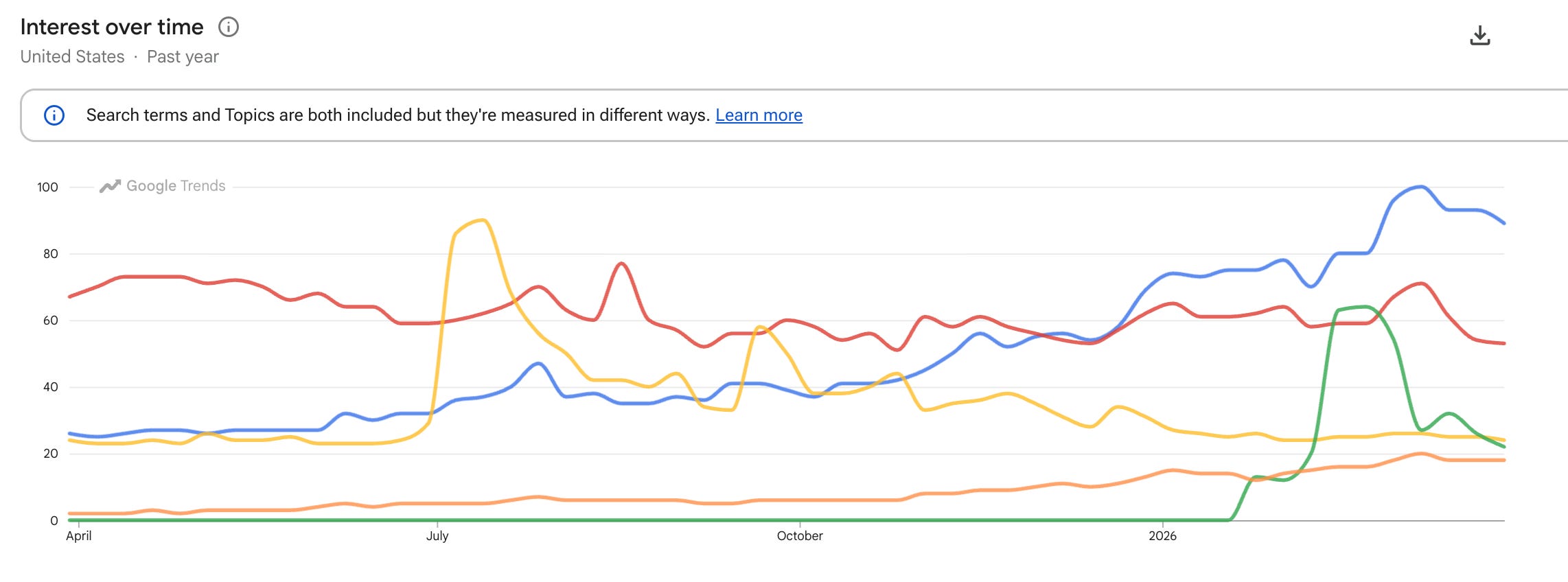
As you can see by the blue line, “peptides” are moving up and up in interest, even overtaking “semaglutide” (Ozempic), late last year.
That orange line, which represents retatrutide, is also telling. Retatrutide is a peptide from Eli Lilly that’s likely to be the next blockbuster pharmaceutical. The crazy thing, though, as this Indianapolis urologist explains on YouTube, is that you can already get it on the grey market (though not from Eli Lilly, the maker with the patent, of course).
I threw OpenClaw in here as another baseline with current topics. I tried comparing these to “ChatGPT” as well but it blew all these topics away, so that shows you where this all sits relatively. AI remains the biggest topic on earth.
Still, interest in peptides generally is rising, and — unless something stunning and concerning gets discovered — that seems unlikely to change.
Beat reporters
The best way to learn about a new topic is to follow it and blog about it yourself.
The second best way is to read the reporters who are teaching themselves by blogging about it.
So far, I have only found two reporters who really seem to be keeping tabs on peptides as an ongoing and developing story (rather than writing the one-off trend pieces — more on those below).
These two scribes are incorporating peptides into their beats:
Lexy Lebsack, Glossy
You may be surprised to learn that I had never visited the beauty site Glossy before, but I had not until I went looking for peptide journalists. What do you know? Peptides have proven to be a big topic in the beauty world, and it seems like Lebsack intends to keep watching these funny little vials move around.
Lebsack has done several pieces on the topic so far, including keeping an eye on the market for pens that make injections easier to do and flexible to dose, beauty patches for easier delivery and RFK Jr’s promise to open this market up.
I have her overview piece in the link round-up following this section, as well.
Katie Palmer, Stat News
No surprise that the health news site had eyes on this topic early. A few people there have done relevant reports, but Palmer seems to have eyes on it now.
Palmer focuses more on policy than products, making her a good companion to Lebsack’s coverage. She got interested once Kennedy became health secretary, with a good report that got into the weeds of facets like compounding pharmacies and what they can get away with offering.
Lately, she’s been keeping an eye on the publicly traded company, Hims and Hers, which has bought a compounding pharmacy and looks set to use its considerably marketing reach to push peptides as much as they can get away with.
We’re on the verge of a kind of medicine that let’s you have more of what you want out of life.
Boston Globe Media-owned Stat News, institutionally, seems skeptical of peptide therapy, but that doesn’t mean its reporters won’t follow it. I can’t help but think that this modality is going to be a blind spot for a lot of reporters just because RFK Jr. is into it. It’s amazing how much political-coding impacts coverage, but — believe me — that is real.
Of course, there probably are other reporters out there who are following this that I didn’t surface. And some I found look like they might be getting set to keep an eye on it, but it’s too soon to say.
That’s who I found. Sorry if I missed a good reporter’s work! Email me links!
What we talk about when we talk about peptides

Correction (March 30, 2026, 12:26 PM CST): At one point in the episode, I compare Ozempic to Wegovy. I should have compared it to Zepbound, instead.
The drive-by explainers
In the early days of a big news topic, reporters have to get up to speed. Reporters get up to speed the way they do everything else: they write stories about them.
So right now it’s easy to find big picture explainers on the topic of peptides, but hard to find nitty gritty coverage of the twists and turns of this developing market.
Coverage of peptides so far basically ranges from “no one should ever touch any pharmaceutical ever that hasn’t been approved by the FDA” to “fuck around and find out.”
Here’s how I would sort the ones I have found on the YOLO-to-pearl-clutching continuum (caveat: none of them are really truly YOLO):
⬇️ YOLO
🧨 Life on Peptides Feels Amazing, Ezra Marcus, New York Mag, Jan. 26, 2026
Over the course of his reporting, Marcus tries two peptides, NAD+ (not technically a peptide) and retatrutide. He even buys the second with bitcoin from abroad. Based.
He also pretends to be a giant distributor while talking to a sales rep in China to see how much he could get if he had the money. Answer: so much.
“I was like, ‘What’s going on? Why do you guys all look so jacked and your skin is really tight and nice? You guys party constantly.’ ” Their response: “Oh, we’re all on peptides.”
🤪 Harder. Better. Faster. Stronger. San Francisco startup Superpower is betting that you need to be hotter and smarter to survive., Arielle Pardes, March 22, 2026
Pardes’ story leans heavily on Max Marchione, the young founder of Superpower, who features heavily in the latest Diamond Rhino podcast.
Pardes actually goes to his office and tries a sample of retatrutide as part of her reporting.
Simone Vincenzi, a machine learning engineer, tells me that he'd heard about retatrutide from bodybuilders, who posted about it constantly on Reddit. "It's the biggest population of experimenters," he says, "because they're not afraid of dying."
🙃 ‘Chinese Peptides’ Are the Latest Biohacking Trend in the Tech World, Jasmine Sun, The New York Times, January 3, 2026
The setting for much of the story is Frontier Tower, which followers of Diamond Rhino will be familiar with. Bonus points for talking to the founder of Vibe Camp, who says injecting peptides takes her back to her bad days with crystal meth.
“We might all be better off if we let the crazy people try the crazy peptides and filter down to the rest of us, instead of the system, which takes 10 years and is meant to protect everyone from everything.”
💁♀️ Injectable peptide therapy went mainstream in 2025, priming consumers for the next big wellness wave, Lexy Lebsack, Glossy, Jan 5, 2026
The previously discussed Lebsack explores how these substances have escaped containment among biohackers and bodybuilders. She even did a companion podcast on peptides.
This one starts with BPC-157, the one that stimulates rapid healing (but might also encourage tumor growth), and ends on a big question: Could there be an unbelievable number of treatments found among the hundreds of synthetic peptides labs can make?
“We know what they can do. We know that there are millions of people in the world now using them for various reasons. So it’ll be really, really hard for the FDA, or any other government oversight, to regulate them. … 2026 is going to be a very interesting year.”
😐 How Peptides Conquered the Internet, PJ Vogt, Search Engine, Feb. 13, 2026
This one connects peptides to looksmaxxing. So if you haven’t had enough Clavicular content just yet, put this one on your Airpods. I quoted from it a fair amount in my peptides podcast.
🫥 It’s About to Be Hot Peptide Summer, Dean Stattmann, GQ, March 9, 2026
This is an ambivalent post, one that seems torn between the idea that pharmaceuticals should only be used to treat a diagnosed ailment and the recognition that it might be nice to feel sharper, stronger or better.
Not all peptide users are 45-year-old Huberman Lab stans with an unexamined fear of aging.2
🥱 The Internet Loves Peptide Therapy, David Dodge, The New York Times, Nov. 18, 2025.
The note I wrote for myself after reading this one was “Everything is about epistemology.” In other words, how does a patient “know” a given therapy works. There’s the Dr. Eric Topol view that the only way you can know anything is if it goes through a giant trial. But a lot of people are happy to take the word of friends at the gym.
Who’s right? Who’s wrong? The answer: Both are. It’s just a question of your risk tolerance, but a lot of reporters prefer to outsource their risk tolerance to bureaucrats and can’t fathom how or why anyone wouldn’t do the same.
Regardless of the method used to increase H.G.H., it’s not clear how much higher levels actually improve strength and build muscle in healthy adults. Some small trials have found modest increases in lean body mass among older men who took these types of growth hormone-releasing peptides, but this didn’t translate to improved strength or recovery.
🛌 How Unregulated Peptides Became the Hottest Thing on the Fringes of Fitness and Anti-Aging, Ashwin Rodrigues, GQ, Sept 27, 2023
But banning a substance only makes it more attractive to a certain kind of guy.
🙄 The Human Lab Rats Injecting Themselves with Peptides, Jonathan Jarry, McGill — Office for Science and Society, Nov 3, 2023
I’m going to have more to say on Jarry’s work later this week.
⬆️ Pearl clutching
Meanwhile, there are going to be a lot of developments to follow in this story. Some topics I’m watching:
Vertical integration of clinics and compounding pharmacies
Testing labs
Lyophilization factories in the U.S.
New uses of promising grey market peptides
Peptide trials.
Influencers.
Lawsuits against distributors of retatrutide.
Investors ready to get into backing peptide startups.
Related services, like testing and diagnostics.
Downsides.
I plan to keep following this topic. Let me know if you have any questions you’d like me to look into or angles that I should pursue.
Peptide entrepreneurship reminds me of the early days of crypto tokens. Officials can fret and worry, but they can’t stop it. People trust themselves more than they trust D.C. now, and the people are ready to feel better.
Note: There’s a fair amount of peptide writing on Substack, but I’m even newer to that. It tends to get pretty technical and a little tough to follow, but I hope to get caught up and I’ll let you know who on BioHackStack interests me the most, once I figure that out myself.
Though maybe they should be. Two women got very sick while being administered peptides at a health festival in Nevada. No one has officially determined the cause, but there’s a decent chance that the reaction wasn’t from the peptides themselves, but infections they acquired from their injections.
I wonder what the 90s GQ writers I grew up on would think of the magazine now mocking guys who like Andrew Huberman today. You’d think those guys would be the GQ target audience.