


Apparently it still needs to be said, so I will say it: Everyone who had money on FTX when it went under in 2022 lost money.
No, really. All of them.
Some lost more. Some lost less. But they all lost money.
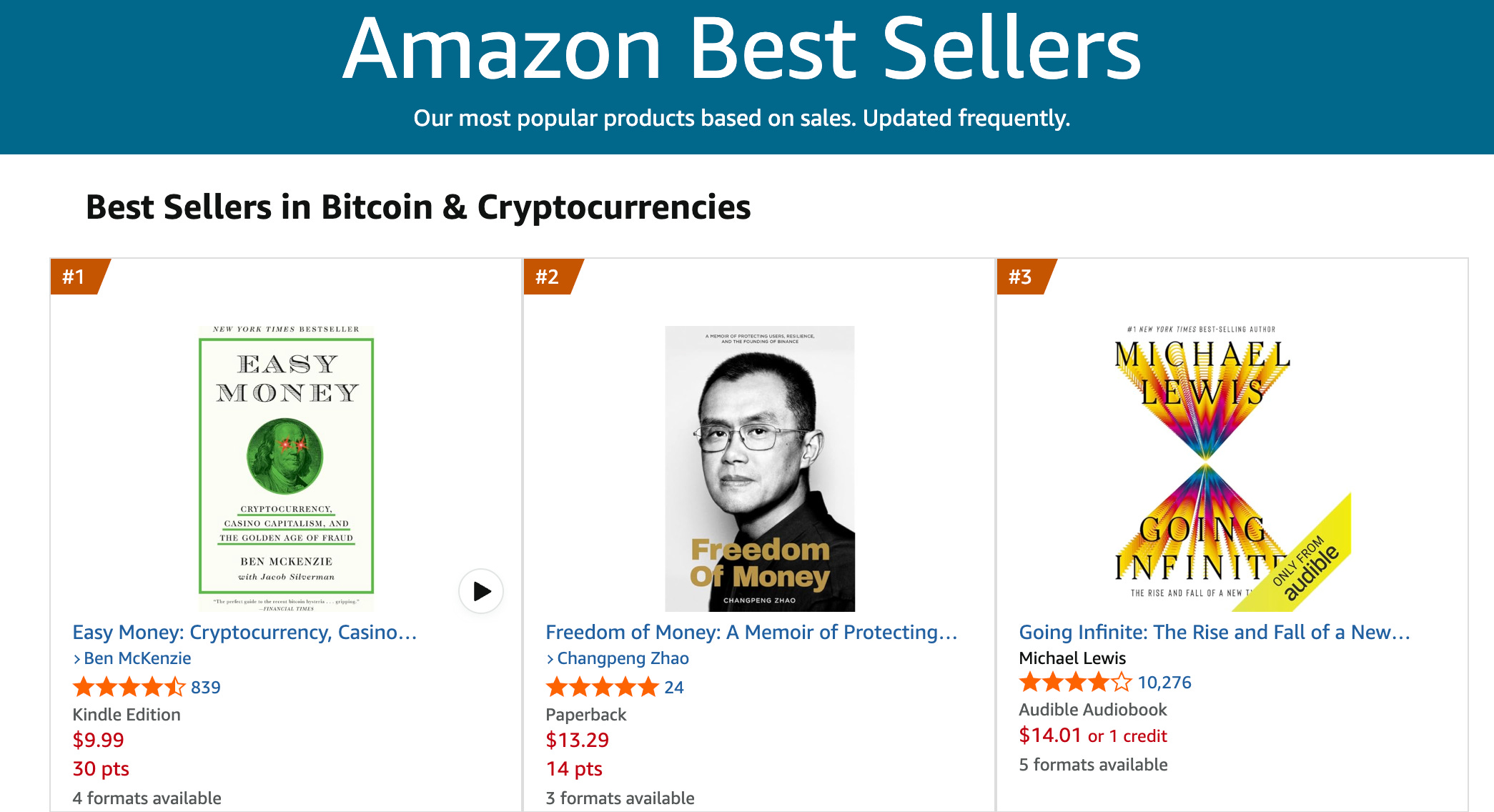
Late last week, The Free Press published an interview with former CEO of Binance, CZ.1 CZ is one of the richest people in the world, almost certainly the richest person in crypto, an ex-con, pardoned by Trump and creator of the Giggle Academy — a free online learning platform.
The occasion for the interview was CZ’s new book, his memoir, Freedom of Money.2
Early in the interview, Rafaela Siewert brings up the fact that SBF got a 25 year sentence for his multi-billion fraud conviction. “Do you think the law was fair to Sam Bankman-Fried, or do you think it went too far?” she asks.
CZ dodges, mostly, just pointing out that SBF didn’t tell people he was using customer deposits to make investments, which meant that, in a liquidity crunch, it wouldn’t have everyone’s assets.3
“I think some people wonder about it because my understanding is no one lost money,” she says, “So, was it overreach?”
Again, CZ dodges on judging it, but he does quibble with the notion that no one lost money. He did not, however, go far enough. I will.
Let’s increase the understanding — once again. Let’s clarify how literally every FTX customer really did lose money.
How people lost money
Most people lost money because they sold their claims before the bankruptcy resolved. One estimate puts the sales at 70% of claims.
Final payments at the end of the bankruptcy went to distressed debt investors, not the actual investors. Distressed debt investors take the risk of losing out on a bankruptcy by buying claims from claimants before the process resolved.
So maybe FTX users sold early and got 15¢ on the dollar, or maybe they sold later and got 60¢. Whatever. They lost money.
And, look, you can say: Well, that was their call but:
A. It doesn’t matter. If the question is: Did most people lose money? Yes, they lost money.
B. Was it? It was SBF’s call to use their money to make investments without disclosing it. They thought their assets would always be there. They couldn’t afford to wait.
Second, even if they didn’t sell, they lost money two other obvious ways: opportunity cost and inflation. They had to go 2.5 years without money that they thought they had in 2022. Who knows how that money might have been useful to people in that intervening time? But not having it, as any economist would tell you, is a real material loss.
At a bare minimum, they could have tucked it into U.S. Treasuries. Recent years have yielded the most generous payout period on those instruments in most people’s lifetimes. That’s real.
And then obviously the value of a dollar has been taking an especially bad beating over the last couple years. So getting back the 2022 value isn’t really the 2022 value any longer.
Third, they didn’t get their crypto back. They got the 2022 dollar value of their crypto deposits.
In the U.S., bankruptcies pay out in the dollar value of whatever was lost. They pay out in dollar value at the time of the bankruptcy. Mostly this works out well and it’s less of a logistical nightmare. But there was a huge cost because this bankruptcy took place as the crypto market turned around again.
Bitcoin is worth about 3X what it was in Nov. 2022 today.
Solana, one of the favorite coins of the FTX crowd, is worth twice what it was in 2022.
Tron is the world’s second-hottest platform for stablecoins. Its coin, TRX, is up 5X since then.
So that’s a real loss for those users. Many people hold coins longterm because they have conviction in them. FTX users didn’t get the opportunity to make that choice.
SBF was very bad
As I wrote at the end of my book about SBF/FTX, the worst people in history are the ones who do the wrong thing for the right reason.
SBF thought he was smarter, more moral and more discriminating than everyone else. For that reason, he was able to justify taking mad risks with other people’s money, because he believed the empire he would build would do so much good for the world that it would justify any past malfeasance.
Like so many before him, he talked himself into becoming a monster.
So, let me go ahead and answer Siewert’s question about whether or not the law went too far: Yes, SBF deserved his sentence.
He’s one of the worst white collar criminals in history. He robbed people of billions of dollars.
To paraphrase Judge Kaplan at the sentencing: It doesn’t matter if you steal $1,000 from someone, bet it all on Craps at the casino, quadruple your money and go back to split your winnings with the victim. What matters is the fact that you robbed them.
It was one of history’s all time biggest robberies. It merits a gigantic sentence.
For those of us who watched the trial, every day was a new jaw dropping revelation of just how terribly he behaved.
And if that wasn’t enough to convince you, the flagrant way he’s demonstrated a complete lack of remorse since being sent away should do it.
I don’t think we’ll ever have a full picture of how far SBF’s grand narcissism went or how far it could have gone, but I’m glad the good people of this world will never again be subject to SBF’s attempts to save us all.
In court, Sam Bankman-Fried got more guilty by the day

A jury of his peers found Sam Bankman-Fried guilty on seven counts in 2023. Then Judge Lewis Kaplan sentenced him to 25 years in prison.
On balance, the interview is not worth watching for readers of this newsletter. It’s very much “my first crypto conversation” sort of content. Most of the interview is an attempt to get CZ to talk about politics and CZ politely declining (just as Daniel Oppenheimer would predict someone with his following would do). The side of CZ I want someone to illuminate is whether or not he’s a good actor in the world of crypto. That’s what I don’t understand. Will he rug the blockchains for an extra million or does he really want to see a rising tide lift all boats? Years of watching him, I really can’t tell. The only interesting part of the interview is watching CZ downplay his access and influence: politically, socially, among investors, in tech — everywhere. He acts like he doesn’t know anyone outside Binance HQ and isn’t particularly privy to any special information. Who actually buys that? Not me.
CZ self-published the book, which is such a flex.
How exchanges work: Customers deposit assets on exchanges, including institutional customers. All these customers trade with each other, but they are all just trading the assets that they have deposited there. So some customers make money and some lose, but that’s just from their individual perspectives. From the macro perspective, the exchange’s perspective, the amount in the exchange stays constantly. It’s just who owns it that changes. So a crypto exchange should always, always, always have 100% of customer money, because it’s the same money. It just changes hands internally.