
Backstage Pass: Love in the time of popecoin
Price collapse // The last on Jemima // Futurity police // The pontiff's picks // Aave COI // Big, very big, partnerships
Backstage Pass: Love in the time of popecoin

Eleven years ago this week, bitcoin was $223.
The 11th largest coin was peercoin.
The 111th was jl777hodl
Six, seven
In this house, we go by CoinGecko, where the bitcoin all-time high in 2021 was a bit over $67,000. So $67,000 is our number.
That’s also the price of bitcoin as I write this, which does not feel good.
When bitcoin broke $100,000 for the first time in December 2024, I wrote that we’ll know this cycle to be different if it doesn’t behave like last time. I made two points that are now relevant for review so that 👏 I 👏 may 👏 do 👏 better 👏.
“Historically, bitcoin has fallen dramatically from its previous three cycle highs, typically to somewhere right around the prior cycle’s height of exuberance.”
and
“If bitcoin’s next bear market ends without it losing 80 to 90% of its value from the peak — say more like 50% — we’ll know something has changed, perhaps for good.”
Thank you, Bitcoin, for finding a way to make this another baffling day in the neighborhood.
Because, first of all, bitcoin price has not fallen 80-90% from its all-time high. Its worst day so far, Feb. 5, was 50% off from the Oct. 6 high. So good news!
But... it once again fell to right around the prior high. You are here.
This is like when you feel something brewing between you and someone else for a long time and when you finally make a move they don’t push you away but they also say “I hate you.”
What am I supposed do here?! Has the triumph of 2021 become the floor of 2026?
Or do we remain nothing more than thralls to a mad god who simply loves to make us dance to a long tune, with a long slow beat and intermittent, mesmerizing crescendoes?
...
Look. I think it’s the former. Would I have felt a lot more confident about everything if it had risen to $160,000 and fallen to $80,000? Yes. That would have been much neater.
At times like these, I try to remember the words of one of the great philosophers of 1993:
No one said it would be easy
But no one said it’d be this hard
The schtick is in
Brave truth-teller and iconoclast Jemima Kelly of the Financial Times wrote a widely shared piece this week, saying that bitcoin’s drop in price has fallen halfway to its inevitable price of $0.
Here’s Kelly in 2018: “We have pointed out that the cryptocurrency boom has been about as obvious a speculative mania as markets have ever seen. We have noted over and over that a private crypto can’t ever be money for the simple reason that governments won’t allow it to be.”1
Here she is in 2022: “But, pah! Everyone knows that crypto goes through several such ‘corrections’ every year. Let’s look at the bIgGeR pIcTuRe here.”
And here she is this past weekend: “Bitcoiners’ excessive confidence — or more precisely the confidence they project, crucial in keeping the whole scheme going — has always been unwarranted, irresponsible and foolhardy. Ever since its creation, bitcoin has been on a journey that will end, splattered on the ground.”
Sorry? Just who is excessively confident? Having some cognitive dissonance here.
One last quote here, from her latest: “This week has shown us that the supply of ‘greater fools’ that bitcoin relies on is drying up.”
Help me out here. If believers are really ebbing, then why do more people hold larger amounts of BTC now than at either of the prior times you said it was sure to fold?
There is as much chance that Kelly will ever grant Bitcoin’s value as there ever was that Henny Youngman would say something nice about his marriage.
Much like Youngman, she’s doing a schtick, but schticks are for comedians, not columnists at the Financial Times.
An honest skeptic is willing to change their mind. They are willing to admit, at some point, by some standard, that they’ve been wrong.2 Kelly will not.
If bitcoin breaks $1 million, Kelly will rush to roast the milestone with a cynic’s glee, because, like a clown getting smashed in the face with a cream pie, it is better than being ignored.
Jemima Kelly’s still got a byline, but she quit working a beat long ago. Instead, she’s just working a hustle.3
Quantum Money, the apotheosis of cypherpunk
This podcast covers a new twist on the intersection of cryptocurrency and quantum computing. It’s got a wow factor.
Here’s a prediction
Barron’s scooped that the CFTC’s Chicago office — its top office — was down from around 20 attorneys to one. Then that one quit. Which is more than a little too bad here at the dawn of generalized oracles: that is, prediction markets.
The more we all watch this unfold, the harder it gets to feel unabashedly enthused about Truth 3.0
Can I imagine a world in which prediction markets surface useful information that’s in the public interest? Yes, 100%.
Do I feel a little weird about normal people betting on weather and whether Rihanna shows up in the Super Bowl halftime show? Uh-huh.
Do I care about insider trading inherently? Not exactly. But do I think we’ve really processed this question as a society? Not even sorta.
I used to think the reckoning would stem from some big, weird event, but I increasingly think the country will just come around to: This is icky, right?
Yes, these markets will for sure shake out some useful truths. The world keeps far too many secrets.
But do I also suspect that some dumb sophomores in frats are going to take their student loans and put them into the playoffs? Yes, and that’s a cancer on the commonweal, but how do we balance the signal and the boys?
I wish I could believe we’d have anything like a dispassionate conversation about futurity, but the trouble is that gambling is like memecoins in that both are much too much like cocaine.
This one will wrap the way controversies in democracies always do, with pearls clutched to dust, apocalyptic tidings and — somehow, always — blaming Trump.
Save yourselves
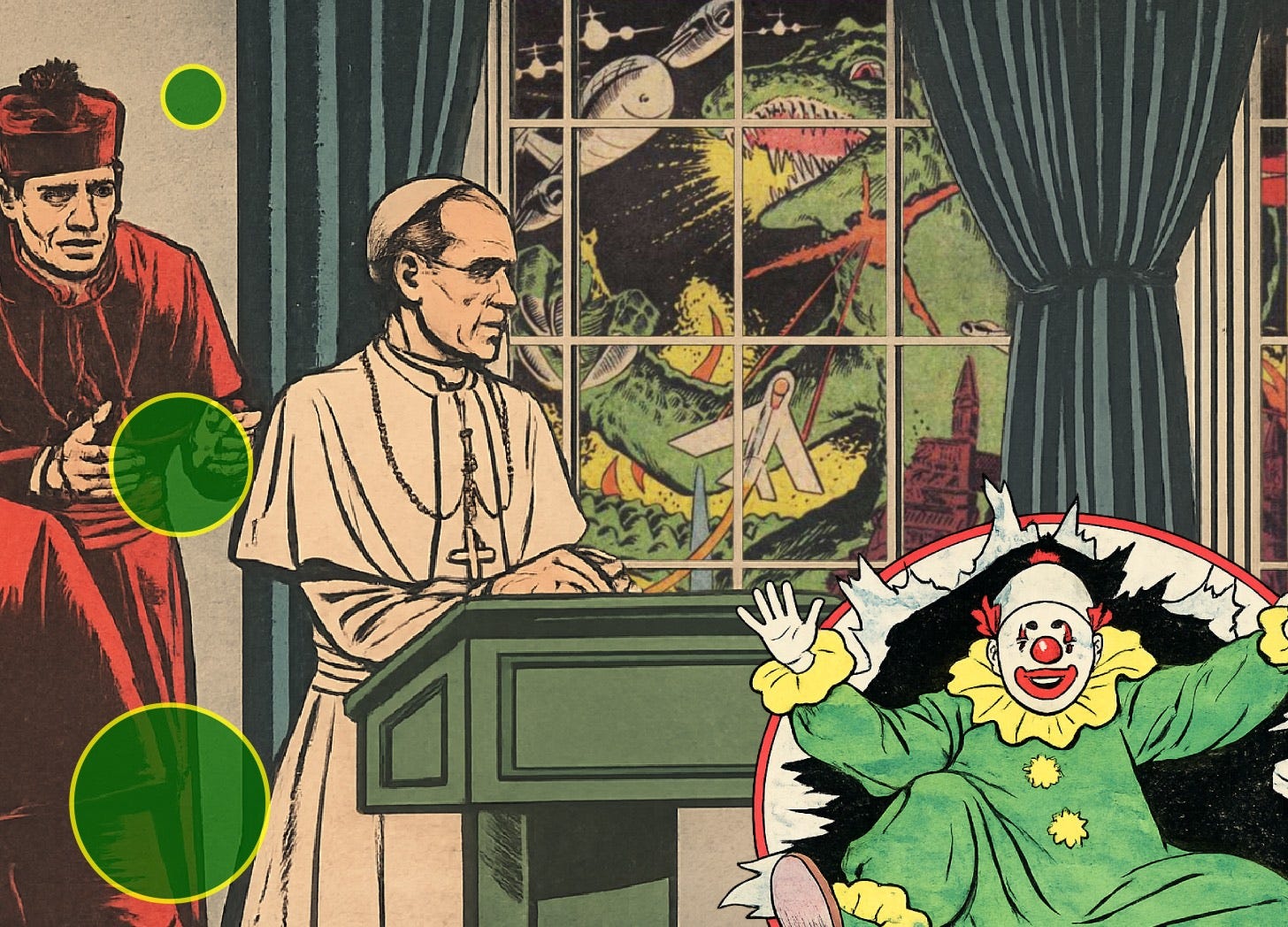
We know the church is about salvation, but can the Vatican save the market as well as souls?
Permit me a slight detour from blockchains here, but I think this item fits, because in the age of financialization, everything is a product, including, apparently, Catholicism. Is popecoin coming? Not yet, but Catholic indices are — straight outta Rome. There’s two, here’s the American one (no one is gonna want the European one, right? There’s salvation and then there’s miracles.)
Amazon, the everything store, is at the top of the index. Look, I was raised Protestant, but I know that if there’s one thing I know Catholicism is not down with, it’s “everything.” In fact, I think there’s some parts of the world that would make the argument that, on a historical basis, the Church has not been down with a whole lot of things.
So how Amazon got in here, I don’t know.
When I started out in the content game, I worked for Observer.com. One of my coworkers had a hit post for Prime Day by pointing out that Amazon had a deal on a 55-gallon drum of lube on discount, and I don’t mean for bike chains here, folks. Yeah. I know the church wants us to be fruitful and multiply, but I also know it doesn’t want us to be quite that. OK? OK.
And don’t get me started on Meta. I will never again use Instagram even though there’s a lot of things on there that it would be useful for me to have access to.
Let’s just say that Instagram has my number. The number it has? It’s not a number that would make the Pope happy. Instagram does not appeal to my highest and best self.
Talk to me about the Catholic principles that these companies abide by, please. I want to know.
Je suis, Aave
Aave is making me want to study up on my French revolutionary history. Rank-and-file members of the AAVE nation do not have the power to disrupt the balance of power governing the product so far, but they’ve been winning in a game of panache.
Aave, the multi-chain money market, is usually the largest decentralized application in DeFi. Its creator, Stani Kulechov, went walkabout for a bit as he tried to disrupt social media. Didn’t work. Now he’s back and he recently flipped a switch to redirect earnings off Aave.com to his company rather than the DAO.
That seemed to be the final insult in what has been long simmering tensions between the king and his people.
Kulechov made the first move by posting a vote to turn all of Aave’s brand assets over to the DAO. He seems to have done so just to show that the Rebel Alliance didn’t have the votes to pass it.
Instead, they opted just not to vote. The second biggest vote on the proposal was not “AYE” but, instead, “ABSTAIN.” It was the governance equivalent of giving the proposal the finger.
In its latest rhetorically adept move, it’s called on all voters in the DAO to vote on a rule that would require disclosing conflicts of interest in any vote and to abstain from any that could unduly benefit them.
In other words, owners of Aave Labs equity could not have voted on December’s proposal.
The new proposal, intriguingly, notes that “COI [conflict-of-interest] voting restrictions cannot be reliably enforced at the onchain voting level.”
In other words, it is more a governance etiquette statement. The proposal establishes norms rather than setting regulations.
Which makes it awkward for Aave’s powers that be to condemn it, but Kulechov has.
This is what reminds me of France. The rebellion grew its forces through a series of symbolic acts. In particular, it forced King Louis XVI to consider and reject a number of proposals that, to the people, seemed reasonable.
Robespierre 2026 is making plans.
The vote will end tomorrow. It looks likely to go down, though it’s closer than December’s face-off. Old organizers will tell you: The action is in the reaction.
The French and the DAO each got their reaction, and we know what ultimately happened in France.
Mothra and King Ghidorah
On one side of the world, Uniswap has hooked up with Securitize so that its whitelisted, KYC’ed users can trade BlackRock’s tokenized money market, BUIDL.
On the other, Sberbank will take bitcoin-backed loans.
I know what you think I’m going to say. You think I’m going to chant the same mantra that the cryptoletariat has been intoning like a Stepford wife back to 2016. “Inssssttttiiiittttuuutttiooonallll adoooooptiooooonnnn.”
Naw, dawg. This is Front Stage Exit.
You see the big money in stories like this. Not me.
I see kaiju.
And they are breaking containment.
Request: I want to do a report on the dying chains out there. I suspect some of the zombies will, in fact, finally go down. What’s tough is coming up with a standard by which to say that one chain or another really is dead. Whatever that standard might be, it is obviously not coin price. So, if you have meaningful evidence of a chain in material decline or tangible criteria suggestions to use to assess whether or not a chain is wobbling dangerously, please hit me up.
Here are standards by which I will start doubting my long-term bullishness on Bitcoin: If new ASICs quit coming out, if publicly traded bitcoin miners fall below 20% of the total hash rate or if less than 600,000 wallets out there hold 1 BTC or more, then I’ll start asking myself serious questions about whether or not Bitcoin can survive. Hold me to them.
Like Jamie Dimon on Bitcoin, this is a topic I plan never to revisit again.


