


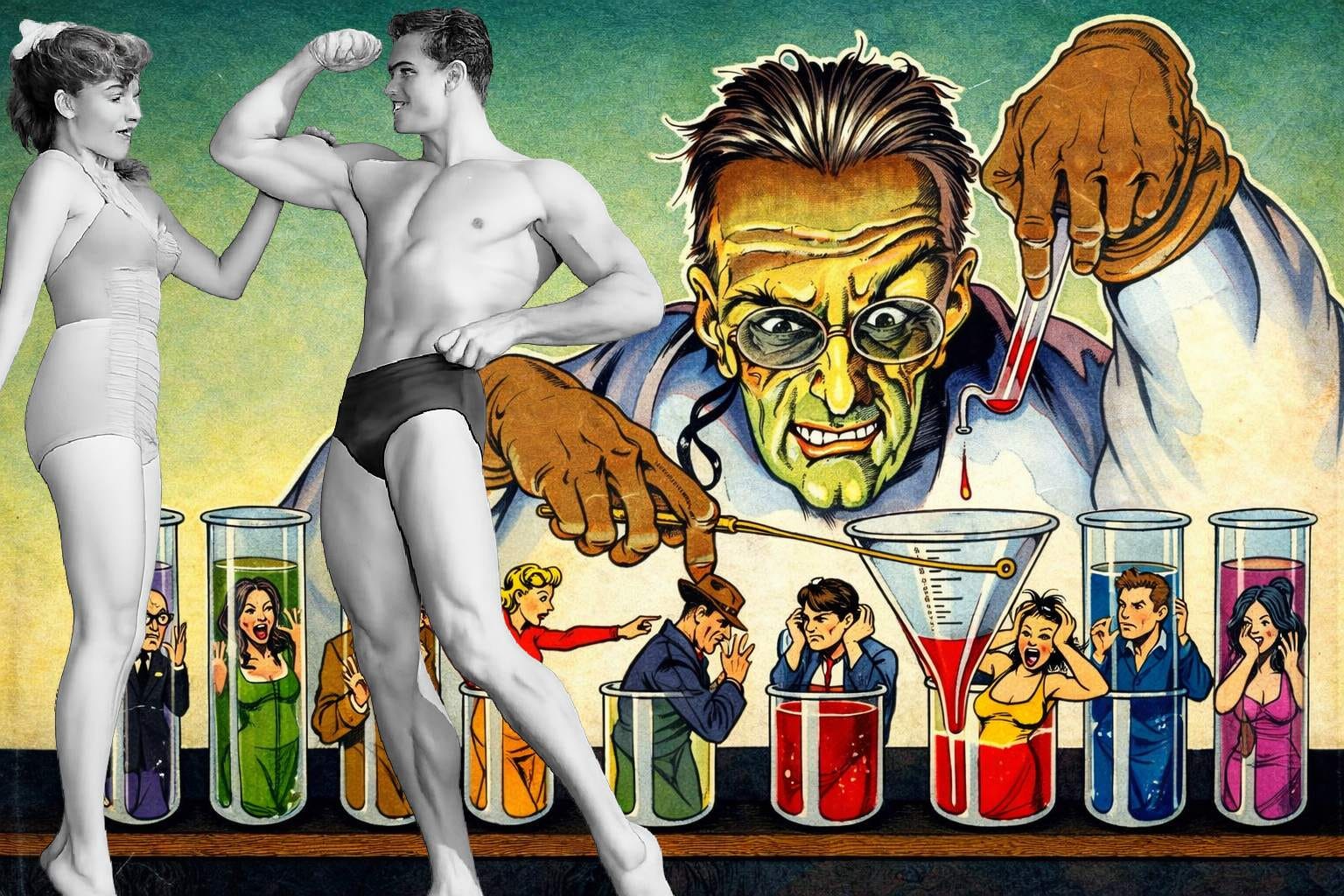
The irony of skeptics is that, as much as they like to point out when claims don’t have sufficient evidence, skeptics often don’t have any evidence of their own to counter those claims.
Get ready for wall-to-wall skepticism as the peptide industry takes off over the next year. The sector will move faster than clinical trials ever could. You’re going to hear about the lack of evidence for these treatments ad nauseam.
Because as much as parts of the public love the surprise of a miracle cure, other parts of the public love the comfort of a stable status quo.
Just remember: The only thing a lack of evidence proves is that there is no evidence. It’s a good cautionary note, but that’s all it is.
There are folks who very much want to make a lack of evidence into something more than it is, but it’s as unscientific to use a lack of evidence to say a treatment won’t work as it is to cite flimsy evidence to say it does.
To an extent: This reticence comes from a good place.
We should all be cautious about jamming stuff inside ourselves with needles. Fair.
But fostering caution doesn’t justify misleading readers about what can and can’t be known.
So, as the peptide story takes off, just be wary that you’re going to see lots of supposed “debunking” pieces and podcasts come out from the traditional press, but very few of them will — if you pay attention — actually debunk anything.
Debunking requires evidence.
Because, I submit, the debunking posts you’ll see will all come to this one point: “There is not adequate scientific evidence to make a clinical claim about peptide treatment.”
This is: A fair point.
This is not: Debunking.

Case in point
Bluesky user Jonathan Jarry works for McGill’s Office of Science and Society. He appeared on a podcast from Glossy that I linked in yesterday’s post about the reporters tracking the general rise of peptides. Jarry showed up on the show as a “debunker.”

By the heuristic I laid out above, he successfully debunked nothing.
Points he makes in this episode:
BPC-157 (the peptide for healing) has lots of rodent studies and one very weak one in humans.
“We are not giant mice,” he says. Contending that lots of drugs that look promising in labs don’t get approved for humans — no further detail.1
Entrepreneurs are quick to commercialize treatments based on preliminary but inconclusive research.
He makes a wild claim that if any of these treatments had value, Big Pharma would obviously develop them. I’m going to circle back to this one in a future post.
He veers off weirdly into this “what can be patented” thing that Martin Shkreli also went off on in his peptide debate on TBPN.
He points out that Ozempic’s success has driven interest in other peptides, but “there’s nothing magic about peptides,” he argues. I think it was an argument. To be honest I couldn’t really tell you what point he thought he was making.
People don’t believe the medical establishment when its professionals say they have run out of options, so people will look elsewhere.
Let me sum this up for you: Nothing was debunked. Some reasonable notes of caution were offered, but that’s it.
He’s got nothing but doubts.
Jarry’s work on the topic preceded the podcast. He came to the topic early, in 2023, with a post titled, “The Human Lab Rats Injecting Themselves With Peptides.” (which I also linked yesterday and said I would have more to say about — I’m not done)
The post makes several points, but none of them rise to a successful debunking. Rather than go through all of them, let me just group them into categories:
People disliked on Bluesky, such as Bryan Johnson and Andrew Huberman, use peptides.
Peptides have a masculine vibe. Also, peptides are Goop for men.
Peptides are being used for life enhancement rather than treating clinical ailments.
Canadian regulators have banned them. Other regulators are skeptical.
The persuasiveness of Jarry’s points will correlate precisely to how readers feel about public media. That’s my own little unsubstantiated claim. Let’s go.
You: The sky is a nice shade of blue.
Skeptics: Citation?
How we know
Geeks love the cliche: “The plural of anecdote is not data.” And it’s not. That is true. But it is information.
Many anecdotes will never be enough information for Medicare to cover a treatment — and it shouldn’t be, but it might be enough information for you.
Let’s say you tried a treatment based on flimsy evidence (friends recommended it), and it worked.
And in that kind of circumstance, Jarry would point out that you can’t really know if the intervention worked. You’ve got motivated reasoning, after all. But you don’t care about how it worked, do you? You care that something did, and that you feel better.
Skeptics love to talk about motivated reasoning, but their reasoning is motivated as well: The skeptical type loves nothing more than telling other people that they are wrong.
They love it so much they don’t wait for proof.
What we talk about when we talk about peptides

Correction (March 30, 2026, 12:26 PM CST): At one point in the episode, I compare Ozempic to Wegovy. I should have compared it to Zepbound, instead.
Note: There’s a lot of topics I want to pursue going forward on this subject.
Who are the big players in which parts of the peptide supply chain? What investors have backed alternative research?
What’s the history and the holdup for Big Pharma in developing peptides?
Is it actually feasible for Big Pharma to develop peptide treatments? What’s the actual story on treatments firms have abandoned?
How should we think about clinical treatment for ailments versus elective treatments for quality of life?
How might standards of evidence vary depending on payment by the state, payment by a third party or self-funded treatment?
How might an individual in the self-funded market assess efficacy versus an executive determining whether or not to cover a particular kind of care?
Who is willing to or pursuing investigations into pharmaceuticals that provide quality-of-life treatments versus ailment care?
If and when quality of life treatments are found to be safe and effective, should they be added to group payments? Are startups targeting coverage as a mechanism for growth?
Have any national health regulators bifurcated regulation of healthcare between entirely elective treatments and collectively covered treatments?
How do individuals protect their health and their pocketbook in the grey market?
How safe are at home shots and can they be made safer?
And, obviously, who is the next hot peptide startup and what’s the next hot peptide treatment?
And one has to ask if the studies in mice even investigated what body builders and beauty enthusiasts are using them for. What clinical trials aim to evaluate and the results sought by people with disposable income often don’t align.